
Every teacher has heard the sentence.
A parent sits across the table during a conference and says, usually with genuine confusion: “But my child doesn’t act like this at home.”
And you know what? You may absolutely be right. Let’s talk about it.
Because if we’re honest, most of us remember being kids ourselves. We remember acting a little different when our friends were around than when we were sitting at the dinner table. We remember testing boundaries, trying to be funny, and trying to look tougher or cooler than we really were.
In other words, we remember discovering that the world outside our home came with a different audience.
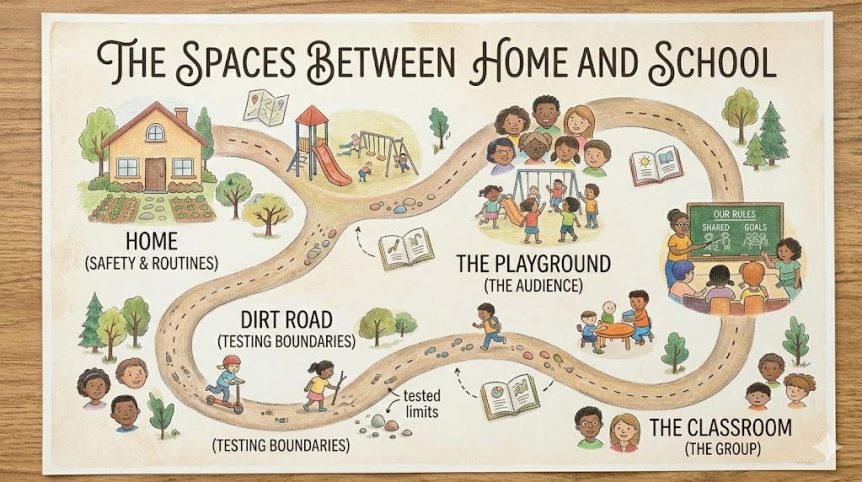
When peers enter the picture, what psychologists call the “audience effect” begins to show up. At home, the environment is familiar and the attention is direct. But school is a different world—a classroom full of students navigating friendships and figuring out where they fit.
Children are not born knowing how to navigate these social pressures; they learn through experience. That “angel” at pickup who was a “firecracker” at recess isn’t being dishonest or manipulative. They are simply learning how to move between different social environments.
Home is where children feel the most secure. School is where they begin figuring out who they are outside that structure. They are practicing how to manage frustration, competition, and the pressure of a group. That process isn’t always smooth, and it often shows up as behavior that no one at home has ever seen.
The Classroom Courtroom
This is where an important challenge can appear during conversations between parents and teachers. Adults can accidentally turn behavior discussions into a courtroom. The teacher presents what happened. The parent feels the need to defend their child. And the child, whether they are in the room or hearing about it later, ends up watching the verdict unfold.
When that happens, the child learns something subtle but powerful: not that the adults in their life are working together to help them grow, but that the adults are arguing about them.
The moment a behavior conversation turns into a courtroom, everyone loses. The teacher feels like they have to prove something. The parent feels like they have to defend something. And the child begins focusing less on correcting the behavior itself and more on which adult will win the argument.
A Better Question
Children don’t need a trial. They need adults who are willing to sit on the same side of the table and ask a better question: What is this moment trying to teach us about how to help this child succeed?
Because behavior is information. It tells us when a child might be overwhelmed, frustrated, or seeking their place in a group. When parents and teachers share what they are seeing instead of competing over who is right, patterns begin to emerge and solutions become possible.
The child learns something important from that kind of cooperation: the adults in their life are not competing with each other. They are on the same team. And for a child trying to navigate a bigger world beyond the walls of home, that kind of teamwork makes all the difference.
The Nerd Academy Lab Note:
We view behavior not as a problem to prosecute, but as information to understand. Children are still learning how to manage frustration, friendships, and expectations in a room full of peers. When we bridge the gap between home and school, we give children something far more valuable than a verdict: guidance.