
Building the Cognitive Infrastructure for Real Readers
In a world saturated with devices, choosing to be screen-free in Pre-K through 3rd grade may seem unusual. For us, it is intentional. At Nerd Academy, early elementary is about one primary objective: building strong readers. We aren’t talking about readers who can memorize predictable books or simply navigate an app. We are focused on real readers—students who can decode unfamiliar words, read fluently, and comprehend deeply. That foundation determines everything that comes next.
The Science Behind Our Approach
Reading is not natural; the human brain was not designed for it. Neuroscientists have shown that learning to read requires the brain to repurpose visual and language circuits to form new neural pathways. One of the most important processes in this development is orthographic mapping.
Orthographic mapping is how the brain permanently stores written words for instant recognition. It happens when a child connects the sounds in a word (phonemes), the letters that represent those sounds (graphemes), and the meaning of the word. This process requires explicit phonics instruction, repetition, handwriting, and direct engagement with text. It does not happen automatically; it is built through consistent, analog practice.
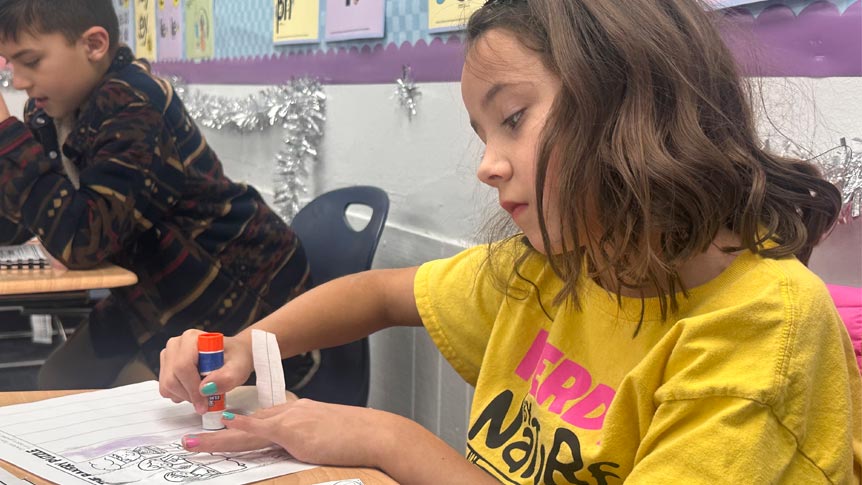
Research on handwriting shows that forming letters by hand strengthens neural encoding and letter recognition more effectively than tapping or typing. The physical act of writing reinforces the sound-symbol connection that fluent reading depends on. This is why K–3 at Nerd Academy focuses heavily on pencil, paper, and teacher-led instruction.
The Three Pillars of Our K–3 Model
- Explicit Phonics and Decoding: Students learn the code of English directly. We do not rely on guessing strategies or digital prompts. They master sound-letter correspondences systematically.
- Fluency and Stamina: Daily reading practice builds automaticity. Reading requires endurance, and deep comprehension requires sustained attention that digital platforms often fragment.
- Mastery-Based Pacing: We use tools like Renaissance STAR assessments to track progress and identify gaps. While students do not use personal devices in daily instruction, we administer brief, supervised digital assessments to ensure no child falls through the cracks. These tools inform instruction; they do not replace it. If a student needs additional work, that takes priority over the calendar.
Why We Protect Early Attention
In the early grades, attention is currency. Every minute spent navigating a tablet interface is a minute not spent strengthening phonemic awareness, handwriting fluency, or collaborative language development. Research shows that excessive screen exposure in early childhood can reduce conversational interaction, and conversational turn-taking is strongly linked to language development, which is directly tied to reading comprehension.
Even well-designed “educational” apps often rely on rapid feedback loops and gamified reward systems. While engaging, that pattern can fragment attention during a developmental window when sustained focus is being built. We prefer the slow-burn satisfaction of finishing a physical chapter book over the instant gratification of a digital badge.
Sequencing for Success
We are not avoiding technology; we are sequencing it. By the end of 3rd grade, students must demonstrate decoding fluency and independent comprehension. Once they transition from “learning to read” to “reading to learn,” technology becomes a powerful amplifier. In upper grades, students use 1:1 devices to:
- Evaluate credible sources and practice digital citizenship.
- Use ChatGPT responsibly for real-world problem solving.
- Write structured JSON prompts to work effectively with large language models.
- Build websites using HTML and CSS.
- Learn programming logic through Scratch.
Platforms like Freckle are used as targeted reinforcement only after written work and teacher-led instruction are complete. Tablets extend learning—they never replace the teacher. AI literacy, coding, and advanced digital research all depend on strong comprehension. A child who reads confidently can leverage technology powerfully; a child who struggles to decode cannot.
Clear, Measured, and Intentional
We use data through STAR assessments, communicate progress clearly with parents, and adjust instruction whenever needed. If comprehension needs reinforcement, that takes precedence over “shiny” tools. Our philosophy is simple: Build strong readers first, then give them every modern tool to thrive. Because when literacy is solid, everything else becomes easier.
And that just makes sense.