
It is a scene played out in every early elementary classroom, a quiet friction that wears at the nerves of even the most patient educators. A teacher is crouched low, intently explaining a math sequence to a struggling student. Suddenly, a shadow falls over the page. A second grader has entered the immediate orbit of the conversation. There is no waiting for a pause, no recognition of the private nature of the interaction. First comes the rhythmic tap on the teacher’s elbow, then the persistent, metronomic repetition of a name: “Mrs. Bennett. Mrs. Bennett. Mrs. Bennett.”
To the adult, this feels like a deliberate act of rudeness, a blatant disregard for the peer currently receiving help. But when the teacher finally looks up and asks for a moment of patience, the child doesn’t offer a contrite apology. Instead, they huff, shoulder their way back to their desk, and mutter that the school is “stupid” or the teacher is “being mean.”
The biological “spotlight” of the K–3 brain creates a world where the self is the only visible actor.
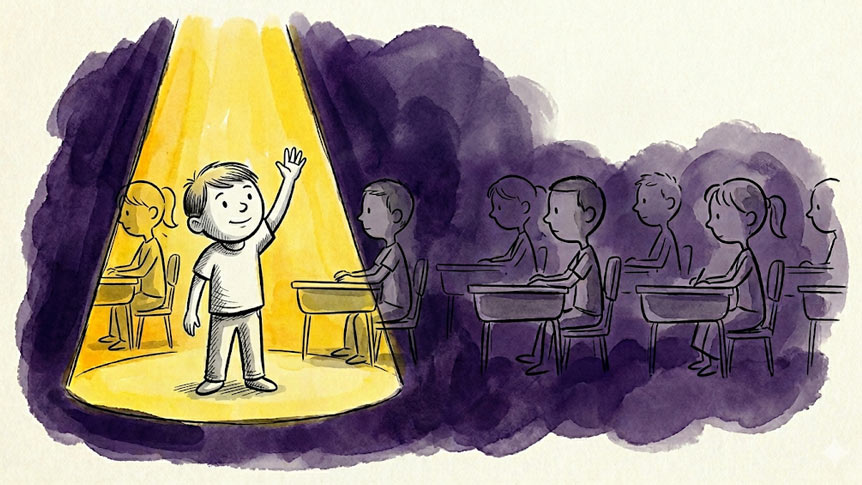
To understand this behavior, we have to move past the immediate sting of the child’s perceived insolence and look at the neurological mechanics of salience. At this developmental stage, a child’s own internal need—be it a broken pencil or a sudden thought—occupies a position of total, blinding importance. It is as if they are standing in a high-voltage spotlight while the rest of the classroom remains in a deep, impenetrable darkness.
When that child hovers inches from your face while you are speaking to someone else, they aren’t “ignoring” your conversation; their brain literally hasn’t ranked your interaction with another student as a functional barrier. In the neurobiology of early childhood, the ability to prioritize the social cues of others is a circuit that is still being wired. They are simply operating within a structural radius of self where their immediate impulse is the only signal loud enough to hear.
“That’s not fair!” is rarely a manifesto; it is more often the sound of a biological release valve.
This lack of inhibitory control creates a jarring mismatch between the child’s intent and the teacher’s reality. When that child eventually lashes out with a comment about the school being “rude” or “stupid,” they aren’t actually making a calculated moral judgment. They are experiencing what neurologists call a verbal discharge.
Their brain had a singular, high-speed goal—to get help—and it hit an unexpected wall. That “huff” and the subsequent accusation are the sounds of a primitive prefrontal cortex trying to process the sudden friction of a “No.” It is the biological equivalent of a car’s brakes screeching when they are slammed on too late. The remark isn’t a character flaw; it’s the exhaust of an engine that doesn’t yet know how to pivot gracefully under pressure.
We are often blinded by the “Big Kid Illusion,” mistaking physical height and verbal fluency for emotional maturity.
Because a third grader can articulate complex thoughts and move through the hallways with independence, we expect them to possess the “group logic” of a much older human. We forget that for many of these children, the transition from home to a classroom of twenty-five peers is a massive neurological shock.
At home, they are often the “Main Character” in a 1-to-1 environment where response latency is low and their needs are met with relative speed. In the crowded ecosystem of a school, they are suddenly asked to be a “Supporting Character,” waiting in a queue that their internal clock cannot yet measure. Research into temporal processing shows that to a seven-year-old, ‘just a minute’ feels less like a measurement of time and more like a sentence to an infinite waiting room.
To bridge this gap, the adult must act as an “External Prefrontal Cortex,” lending the child the logic their brain cannot yet build.
If we treat the hovering and tapping as a moral failing, we respond with a reprimand that the child’s stressed brain cannot actually process. Instead, we have to provide the physical scaffolding that their brain isn’t yet producing. This means moving beyond “Stop interrupting” and toward visible, concrete structures: a hand placed gently on their hand to acknowledge their presence without stopping your current conversation, or a physical “waiting anchor” that turns the invisible concept of a turn into a tangible reality.
We are effectively providing the “brakes” until theirs are strong enough to hold. When we stop reacting to the perceived “rudeness” and start addressing the biological constraint, we stop being the antagonist in their “unfair” world and start becoming the architects of their success.
From Theory to the Classroom: What This Looks Like at 10:17 AM
Understanding the “why” matters, but classrooms don’t run on theory. They run on moments, interruptions, split-second decisions when you’re already helping one student and another voice cuts in.
So the question isn’t just why this happens. It’s what you do right then, without turning the moment into a power struggle.
If the child’s brain doesn’t have the brakes yet, we stop demanding better driving and start building the braking system in real time. This is what that actually looks like.
- Give Waiting a Physical Shape
“Wait your turn” is invisible, and that’s the problem. Instead, make waiting something the child can do. A waiting spot, a chair, or a simple hand-on-arm system where they place their hand on you and you cover it when they’ve been acknowledged. No words, no interruption, just a quiet signal: I see you, you’re next. - Make Time Visible
When you say “just a minute,” their brain hears uncertainty, not time. That uncertainty turns into pressure, and pressure turns into “this is stupid.” Use a visual timer or map the queue out loud: “You’re number two, I’m finishing with her, then you.” Now the wait has structure, and structure lowers the stress enough for self-control to hold. - Narrate the Pivot, Don’t Fight the Emotion
When the “That’s not fair” hits, it’s not a debate, it’s overflow. If you argue fairness, you lose the moment. Instead, translate what their brain is struggling to do: “Your brain is ready to go right now, but the pause button is hard to push. Let’s check the timer.” You’re not correcting behavior, you’re coaching a system that isn’t finished yet.
When you start seeing interruption as a missing skill instead of a bad attitude, the whole interaction shifts, not just for them, but for you.