
01: When Reading Becomes a Struggle
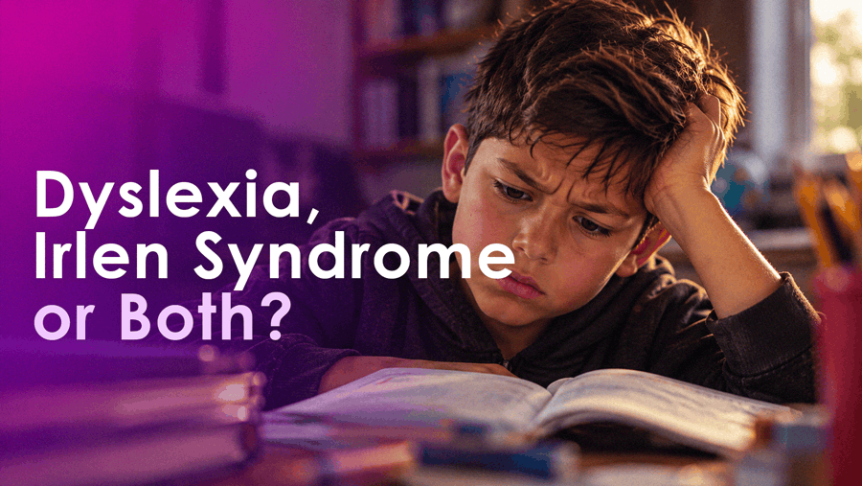
Picture a child sitting at a desk, staring at an open page. The words are right in front of them, but reading is taking an extraordinary amount of effort. You might see them sigh heavily, slouch, or repeatedly shift in their chair. As a parent watching this scene, it is easy to assume the breakdown comes down to a simple matter of motivation or attention. The reality is far more complex. Consider how two children might demonstrate the exact same frustration at a desk for entirely different reasons:
- Example A: A child is trying to read, but their brain is struggling to decode the letters. The written symbols aren’t mapping smoothly onto the speech sounds they use fluently every day in conversation.
- Example B: A child is trying to read, but the white page itself feels physically uncomfortable. They report that the sharp contrast between dark text and the bright background causes visual strain, making the print appear unstable.
These are illustrative examples, not diagnostic profiles. Children may experience reading difficulties for many reasons, and similar behaviors do not necessarily indicate the same underlying problem. When a child hits a wall with reading, understanding what is making reading difficult matters. Confusing a language-based decoding difficulty with a visual comfort issue can lead to mismatched interventions. A child may spend months working hard without receiving the support they actually need.
02: Dyslexia: When Learning the Written Code Is Difficult
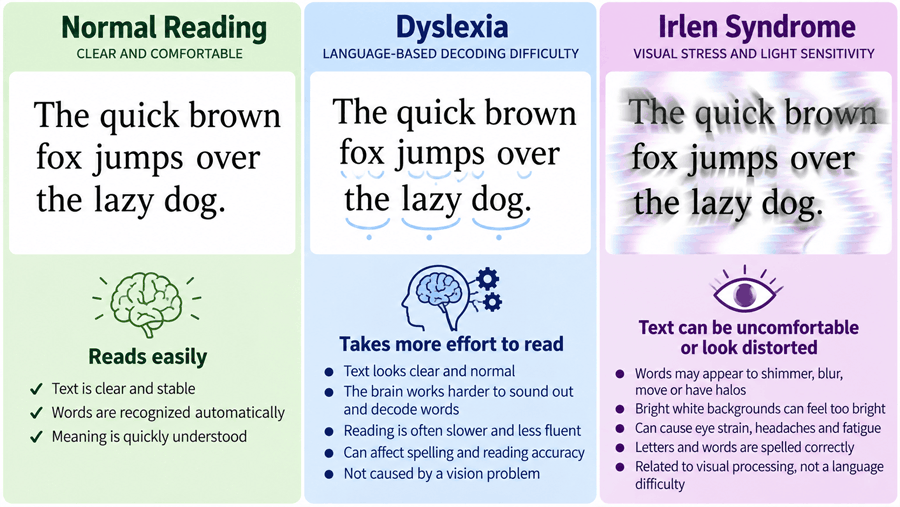
Dyslexia is a language-based learning disability characterized by persistent difficulties with accurate or fluent word reading, spelling, or both. Many people associate dyslexia primarily with phonological processing, the ability to recognize and manipulate the individual speech sounds that make up words. However, the International Dyslexia Association’s updated 2025 definition recognizes that phonological and morphological processing difficulties are common, but not universal. Dyslexia exists along a continuum of severity. Its causes are complex and involve combinations of genetic, neurobiological, and environmental influences.
To understand what a child with dyslexia experiences, it helps to examine three important components of reading:
- Sound-Symbol Correspondence: Learning how written letters and letter combinations represent the speech sounds in spoken words. For example, understanding that the letters sh commonly represent the /sh/ sound in words such as ship.
- Decoding: Applying knowledge of letter-sound relationships to read unfamiliar written words. This includes identifying sounds and blending them into recognizable words.
- Automatic Word Recognition: Developing the ability to recognize familiar written words quickly and accurately without having to consciously sound out every letter.
A child experiencing difficulties in these areas might understand spoken language well and follow a complex story read aloud with ease, yet struggle when asked to read those same words independently. The difficulty isn’t necessarily understanding the story. It may be accessing the written words in the first place.
Dispelling the Myths
To advocate effectively for children with dyslexia, we need to leave several misconceptions behind.
- Myth 1: Dyslexia is an intelligence problem.
Dyslexia occurs across the full range of intellectual abilities. It is not an intelligence deficit, nor does it automatically mean a child possesses exceptional intelligence.
- Myth 2: Children with dyslexia just aren’t trying hard enough.
Reading difficulties are not evidence of laziness or poor motivation. Reading can require substantially more conscious effort for a child with dyslexia, particularly before word recognition becomes automatic.
- Myth 3: Dyslexia means seeing letters backwards.
Dyslexia is not a physical vision defect that causes children to see letters or entire words reversed. Confusing letters such as b and d can occur during normal early literacy development. Although some children with dyslexia also make letter-reversal errors, these errors are neither unique to dyslexia nor sufficient for identifying it. The central difficulty involves written language processing, particularly accurate and fluent word reading and spelling.
03: Irlen Syndrome: When Reading Causes Visual Discomfort
For some children, reading difficulties are accompanied by physical discomfort when looking at printed text. A child might describe words appearing to move, bright pages becoming uncomfortable, or text seeming difficult to focus on. These experiences are sometimes discussed under the terms visual stress, Meares-Irlen syndrome, Irlen syndrome, or scotopic sensitivity syndrome. However, an important distinction exists: visual stress describes a collection of reported experiences, while Irlen syndrome is a proposed diagnostic explanation whose validity remains scientifically disputed.
The Reported Experience
Children reporting visual stress may describe several unsettling sensations while reading:
- Apparent movement or distortion: Letters or words seem to shake, shimmer, blur, float, or run together.
- Light sensitivity: Bright white pages or strong contrast may produce discomfort, glare, eyestrain, or headaches.
- Difficulty maintaining visual comfort: Lines may appear crowded or unstable, and the child may lose their place while reading.
These descriptions can be difficult for children to communicate. A child might simply say that the page hurts their eyes, the words look funny, or reading gives them a headache. Such complaints deserve attention, regardless of whether they fit a particular diagnostic label.
Understanding the Research
Irlen syndrome has been the subject of research and controversy for decades. Proponents suggest that certain individuals experience abnormal responses to particular wavelengths of light, potentially affecting visual processing and creating discomfort or perceptual distortion. This remains a proposed explanation rather than an established neurological mechanism. A 2019 systematic review published in Arquivos de Neuro-Psiquiatria examined research on Irlen syndrome and concluded that the available evidence was insufficient to establish it as a distinct disorder or demonstrate reliable treatment effectiveness. This does not mean that people reporting visual discomfort are inventing their symptoms.
It means that experiencing a symptom and establishing its underlying neurological cause are two different scientific questions. Visual discomfort may occur for several reasons, including recognized eye conditions, lighting conditions, or other factors. Not every complaint has an easily identifiable ocular cause. Persistent blurriness, headaches, apparent text movement, or difficulty maintaining comfortable vision should be evaluated by an appropriately qualified eye care professional.
What About Colored Overlays and Tinted Lenses?
Colored overlays are transparent sheets or reading strips placed over printed material. Tinted lenses serve a similar purpose by modifying the light reaching the eyes. Some studies have reported improvements in reading comfort, speed, or reported visual symptoms among selected individuals using colored filters. However, controlled research has produced inconsistent findings. Some studies have found little or no reliable advantage over comparison filters or placebo conditions.
The clinical effectiveness of colored overlays and precision-tinted lenses for Irlen syndrome therefore remains disputed. A child may prefer reading through a particular color, and that preference can be acknowledged without assuming it establishes a diagnosis or proves a particular neurological mechanism. Colored overlays do not teach decoding, correct phonological processing difficulties, or replace appropriate reading instruction. They should also never substitute for a comprehensive eye examination when a child reports persistent visual symptoms.
04: Dyslexia vs. Irlen Syndrome: What’s Different?
Understanding the distinction between a reading disability and reported visual discomfort can help parents ask better questions. Dyslexia is an established language-based learning disability. Irlen syndrome is a disputed diagnostic explanation for certain visual symptoms. A child experiencing difficulty with printed text may need assessment of reading skills, vision, or both.
What Parents Might Observe
| What parents observe | What it may suggest |
|---|---|
| A child understands stories read aloud but struggles to read words independently. | A word-reading difficulty that warrants evaluation for dyslexia. |
| A child struggles to blend individual speech sounds into words. | A phonemic awareness difficulty that may affect decoding development. |
| A child reports shimmering text, blur, headaches, or glare. | Visual symptoms warranting a comprehensive professional eye examination. |
| A child prefers cream-colored paper but still struggles to decode unfamiliar words. | A comfort preference that may coexist with an unresolved decoding difficulty. |
| A child avoids reading, jokes, or becomes disruptive during literacy lessons. | Possible frustration requiring academic, environmental, behavioral, or emotional investigation, not evidence of one particular diagnosis. |
These observations are clues, not diagnostic tests. No individual behavior or symptom can reliably distinguish every possible cause of reading difficulty.
Can a Child Experience Both?
Yes. A child with dyslexia can also experience visual discomfort while reading. For example, a child may have difficulty decoding unfamiliar words while also experiencing headaches or glare sensitivity during extended reading sessions. Both experiences deserve attention. However, experiencing visual discomfort alongside dyslexia does not independently establish an Irlen syndrome diagnosis.
The goal is not to collect labels. It is to identify the specific barriers affecting the child’s reading and address each appropriately.
05: The Emotional Side: What Children May Be Experiencing
When reading becomes an exhausting, uphill battle, the consequences can extend beyond academics. Children may recognize the difference between their effort and their performance long before they understand why the difference exists.
The Weight of Invisible Fatigue
For a child struggling with word recognition or experiencing visual discomfort, ordinary reading tasks may require sustained effort. While an experienced reader recognizes many familiar words automatically, a child with decoding difficulties may need to consciously work through unfamiliar letter patterns. That additional effort can make reading slower and more tiring. By the time a child returns home, they may already have spent considerable energy navigating reading demands throughout the school day. What looks like resistance to another reading assignment may sometimes reflect significant cognitive fatigue.
This doesn’t mean every child with a reading difficulty experiences exhaustion, but it is an important possibility for parents and educators to consider.
Classroom Comparisons and Self-Doubt
During the early elementary years, children increasingly notice differences between their performance and that of their classmates. Watching peers finish a reading passage quickly while struggling to complete the same assignment can contribute to:
- Performance Anxiety: Fear of reading aloud, timed assessments, or being called on unexpectedly.
- Shame and Withdrawal: Avoiding participation or describing a task as boring to escape the possibility of failure.
- Reduced Confidence: Beginning to interpret academic difficulty as evidence of being less capable than classmates.
These outcomes are not inevitable. Appropriate instruction, early support, and a respectful classroom environment can help protect children’s confidence.
Recognizing Defensive Behaviors
Children do not always possess the vocabulary to describe their academic frustrations.
Sometimes that frustration becomes visible through behavior.
- The Class Clown: A child may crack jokes or interrupt a lesson to redirect attention away from a difficult reading or writing task.
- Defiance and Avoidance: A child may argue when reading begins, repeatedly delay starting, or request frequent breaks during literacy activities.
- Disengagement: A child may stare at the page, put their head down, or refuse to begin an assignment.
These behaviors have many possible causes, including attention difficulties, emotional distress, classroom conditions, and unmet instructional needs. They should prompt investigation rather than an immediate assumption that dyslexia or visual stress is responsible.
How Parents Can Respond Effectively
Support does not require abandoning expectations. Parents can acknowledge that reading feels difficult while continuing to reinforce appropriate behavior and persistence. For example: “I know reading this page feels hard and tiring right now, and it’s okay to take a short break. But it’s not okay to throw your pencil. Let’s take two minutes, then we’ll work through the next two lines together.”
The goal is supportive accountability: recognizing genuine difficulty without excusing unsafe or inappropriate behavior, and without overlooking an underlying instructional problem.
06: What Actually Helps? Understanding the Evidence
Parents navigating reading difficulties encounter an enormous range of educational programs, commercial interventions, accommodations, and competing claims. Separating those options according to the available evidence can help families make better decisions.
1. Research-Supported Instruction: The Foundation
Reading development depends on multiple connected skills. For children with dyslexia and other word-reading difficulties, effective instruction often requires explicit, systematic teaching matched to the child’s needs. Important instructional components include:
- Phonemic Awareness: Recognizing, isolating, blending, and manipulating the individual sounds in spoken words.
- Phonics: Learning how written letters and spelling patterns represent speech sounds.
- Decoding and Spelling: Applying knowledge of sound-symbol relationships to read and write words.
- Fluency: Developing accurate, increasingly automatic reading so attention becomes available for comprehension.
- Language and Comprehension: Building vocabulary, background knowledge, syntax, and the ability to understand connected text.
These components are supported by the broader body of interdisciplinary research commonly referred to as the Science of Reading. Instruction should be adjusted according to a student’s demonstrated skills and progress rather than relying exclusively on a particular program’s name or marketing claims.
What About Orton-Gillingham?
Orton-Gillingham is a longstanding instructional approach commonly associated with dyslexia intervention. A 2021 meta-analysis published in Exceptional Children examined Orton-Gillingham interventions and found that the pooled effects did not reach statistical significance. The researchers also identified a need for further high-quality studies. That finding does not establish that all multisensory approaches are ineffective. Instead, it reinforces the importance of evaluating instructional methods through demonstrated reading outcomes rather than brand names or proposed mechanisms.
2. Helpful Accommodations: Building Access
Accommodations can make educational materials more accessible while children continue developing reading skills. They do not eliminate dyslexia or directly teach decoding, but they may reduce unnecessary barriers. Examples include:
- Audiobooks and Text-to-Speech: Providing access to age-appropriate literature, science, history, and other content without making independent decoding the only way to obtain information.
- Extended Time: Allowing additional time for reading-heavy assessments when an individual evaluation indicates it is appropriate.
- Reading Guides: Using a simple line tracker or reading window to help maintain place in a text.
- Accessible Formatting: Adjusting text size, line spacing, or presentation to improve readability and comfort.
The appropriate accommodations depend on the child’s individual needs. Accommodations provide access. Targeted instruction develops reading skills. These approaches can work together rather than compete with one another.
3. Treatments With Disputed or Uncertain Effectiveness
Some interventions are promoted for reading difficulties despite limited or inconsistent evidence. Parents should examine such claims carefully, particularly when a treatment promises to correct several unrelated problems.
Colored Overlays and Tinted Lenses
Some individuals report improved reading comfort when using colored filters. However, evidence for their clinical effectiveness as a treatment for Irlen syndrome remains inconsistent. They do not address the language-based decoding difficulties associated with dyslexia.
Vision Therapy for Dyslexia
Certain diagnosed eye conditions, such as symptomatic convergence insufficiency, have established treatments. However, visual exercises and vision therapy have not been shown to treat the underlying language-based difficulties associated with dyslexia. The American Academy of Pediatrics and collaborating ophthalmology organizations caution against presenting vision therapy as a treatment for dyslexia.
Alternative Cognitive Exercises
Programs claiming to correct reading disabilities through balance exercises, generalized brain-training games, or dietary supplements should be evaluated against rigorous scientific evidence. Such approaches should not replace structured reading instruction with demonstrated benefits.
07: What Happens When Reading Difficulties Follow Children into Adulthood?
A common misconception is that dyslexia is a childhood difficulty that disappears after graduation. Dyslexia is persistent, although its effects and the strategies people use to manage it can change considerably over time. Adults with dyslexia may encounter challenges involving rapid email correspondence, lengthy reports, unfamiliar terminology, spelling, or reading material aloud without preparation. Many develop compensatory strategies that support their work and everyday responsibilities.
These may include:
- Using text-to-speech software to review written material.
- Using dictation tools to assist with written communication.
- Organizing responsibilities through calendars, checklists, and project-management systems.
- Requesting accessible materials or appropriate workplace accommodations.
- Developing professional strengths and strategies that help them navigate reading-intensive tasks.
The experience varies considerably. Dyslexia does not determine a person’s career, intelligence, or professional potential. For adults who struggled throughout school without understanding why, identification later in life can provide useful context. It may help explain longstanding difficulties, guide decisions about support, and challenge inaccurate assumptions about intelligence or effort.
08: A Parent’s Action Plan: What to Do Next
When a child struggles with reading, finding the right starting point can feel overwhelming. Rather than guessing at a label, parents can take several practical steps to understand the difficulty and begin appropriate support. Reading evaluations and medical assessments do not have to occur in a rigid sequence. A child showing signs of dyslexia should not have to wait for an eye examination before an educational evaluation or appropriate reading support can begin. Vision and hearing concerns should be addressed promptly, but those processes can occur alongside educational assessment and intervention.
Step 1: Document the Specific Difficulties
Keep a brief record of what happens when your child reads. Look for patterns involving:
- Difficulty blending speech sounds into words.
- Trouble reading unfamiliar words.
- Frequent guessing based on pictures or surrounding sentences.
- Persistent spelling difficulties.
- Complaints about glare, headaches, blurriness, or apparent text movement.
- Avoidance or frustration during particular reading activities.
Record what the child reports, what you observe, and when difficulties occur. A symptom log does not establish a diagnosis, but it can provide useful information for educators and clinicians.
Step 2: Request an Educational Evaluation
If you suspect dyslexia or another learning disability, request an appropriate educational evaluation. You do not need to wait for your child to fail an entire grading period before raising concerns. An evaluation can help identify difficulties involving word reading, decoding, spelling, phonological processing, and related skills. Parents can request a special education evaluation through the appropriate public school district.
Step 3: Address Visual Symptoms
When a child reports persistent blurred vision, headaches, shimmering text, double vision, or visual discomfort, arrange an examination with a qualified pediatric eye care professional. An examination can assess eye health, refractive errors, eye alignment, focusing, and other clinically relevant concerns. An Irlen screening or commercial overlay assessment should not replace this evaluation.
Step 4: Begin Appropriate Reading Support
Children with identified reading difficulties should receive instruction targeting the skills they need to develop. Support should not be unnecessarily delayed while families wait for every assessment or appointment to be completed. Instructional progress should be monitored so educators can determine whether the approach is working or needs adjustment.
Navigating Texas Evaluation Pathways
For families in Texas, the Texas Education Agency provides specific procedures and timelines for special education evaluations through public school districts.
15 School Days: Response to a Written Request
When a parent submits a written request for a special education evaluation to the district’s special education director or an appropriate district administrative employee, such as a principal, the district generally must respond within 15 school days. The response must include required written notice proposing an evaluation or explaining the refusal, along with applicable procedural information. Parents may also make verbal requests, although the specific Texas 15-school-day response deadline is triggered by qualifying written requests.
45 School Days: Initial Evaluation
After the district obtains informed written parental consent, it generally has 45 school days to complete the Full and Individual Initial Evaluation (FIIE) and produce the evaluation report.
30 Calendar Days: Initial ARD Meeting
The Admission, Review, and Dismissal (ARD) committee generally must meet within 30 calendar days after completion of the evaluation report to determine special education eligibility and address the student’s educational needs. Exceptions and special rules apply, including certain student absence and end-of-school-year situations. Parents should consult current TEA guidance for the deadlines applicable to their circumstances.
What About Families Attending Private Schools?
Under the federal Individuals with Disabilities Education Act (IDEA), public school districts have Child Find responsibilities covering eligible children attending parent-selected private schools. This means families attending a private school can still seek a publicly funded special education evaluation when a qualifying disability is suspected. Texas guidance addresses evaluation responsibilities involving the school district where the private school is located and, in appropriate circumstances, the student’s district of residence. However, an important distinction exists between evaluation rights and individual service entitlements. A child attending a parent-selected private school does not automatically have the same entitlement to individual special education services at that private school as a student enrolled in public school.
Families should discuss available evaluation and service options directly with the responsible district. For detailed guidance, visit the Texas Education Agency’s Special Education Resources.
09: How Nerd Academy Approaches Reading Difficulties
At Nerd Academy, we do not believe a child’s reading struggles should automatically be attributed to motivation, effort, or intelligence. We believe those struggles deserve careful attention. Our approach emphasizes targeted instructional assessment, progress monitoring, and collaboration with families. We do not attempt to independently diagnose medical or ocular conditions. When students report persistent visual or physical symptoms, we encourage families to seek an appropriate professional evaluation.
Grounded in the Science of Reading
Our literacy instruction emphasizes foundational reading skills, including explicit, systematic phonics, decoding, spelling patterns, and the development of accurate and automatic word recognition. These instructional practices reflect research into how children learn to read and what helps students experiencing reading difficulties. We teach children to examine written words carefully, connect letters with sounds, and develop the skills required to read increasingly complex material. We do not encourage children to substitute contextual guessing for accurate word decoding.
Pencils Before Pixels
Our Pencils Before Pixels philosophy complements our literacy instruction but serves a different purpose. The Science of Reading informs how we teach reading. Pencils Before Pixels reflects our approach to using technology during early childhood education. By prioritizing books, handwriting, teacher-directed instruction, and direct interaction with printed language during the foundational years, we aim to develop essential academic skills before introducing unnecessary digital dependence. Technology can provide valuable accommodations and educational access when appropriate, but it is not a substitute for carefully planned instruction.
Collaboration Over Assumption
We work with families to examine observable reading skills, monitor academic progress, and identify when additional evaluation or support may be needed. When a child demonstrates signs of visual discomfort, we encourage parents to document those experiences and seek appropriate professional advice while continuing to address the child’s educational needs. Our responsibility is not to assign a label to every struggle. It is to respond thoughtfully, use reliable instructional practices, and ensure that concerns are not dismissed simply because a child appears distracted, frustrated, or unwilling to participate. Every child deserves reading instruction grounded in evidence, careful monitoring of their progress, and a learning environment that recognizes effort without lowering expectations.
Research & References
- International Dyslexia Association. (2025). Definition of Dyslexia. Updated definition adopted October 22, 2025. Read the official definition.
- Miyasaka, J. D. S., Vieira, R. V. G., Novalo-Goto, E. S., Montagna, E., & Wajnsztejn, R. (2019). Irlen syndrome: Systematic review and level of evidence analysis. Arquivos de Neuro-Psiquiatria, 77(3), 194–207. https://doi.org/10.1590/0004-282X20190014.
- American Academy of Pediatrics, American Academy of Ophthalmology, American Association for Pediatric Ophthalmology and Strabismus, & American Association of Certified Orthoptists. (2009). Learning disabilities, dyslexia, and vision. Pediatrics, 124(2), 837–844. https://doi.org/10.1542/peds.2009-1445.
- Stevens, E. A., Austin, C., Moore, C., Scammacca, N., Boucher, A. N., & Vaughn, S. (2021). Current state of the evidence: Examining the effects of Orton-Gillingham reading interventions for students with or at risk for word-level reading disabilities. Exceptional Children, 87(4), 397–417. https://doi.org/10.1177/0014402921993406.
- Texas Education Agency. Evaluation and Child Find Resources. Guidance concerning parental evaluation requests, special education evaluation timelines, and ARD committee procedures. Texas SPED Support: Evaluation.
- Texas Education Agency. Senate Bill 2: Education Savings Accounts and Children with Disabilities. Guidance clarifying Child Find responsibilities and evaluation timelines for children not enrolled in public schools. Read TEA guidance.
Educational information only. This article is not a substitute for individualized medical, psychological, or educational evaluation.